Fright Night

There is nothing quite so disappointing as the run-up to Halloween in Britain. I could go on about the complaints from natives that it’s “too commercial” or the stores that have nary a Candy Corn,  and the paltry selection of ghoulish decor (trick-or-treating isn’t the unquestionable norm here), but nothing sums-up the Brits’ general misunderstanding of this cherished American festival more than a recipe from this week’s local paper. It’s so painfully misguided, brace yourselves.

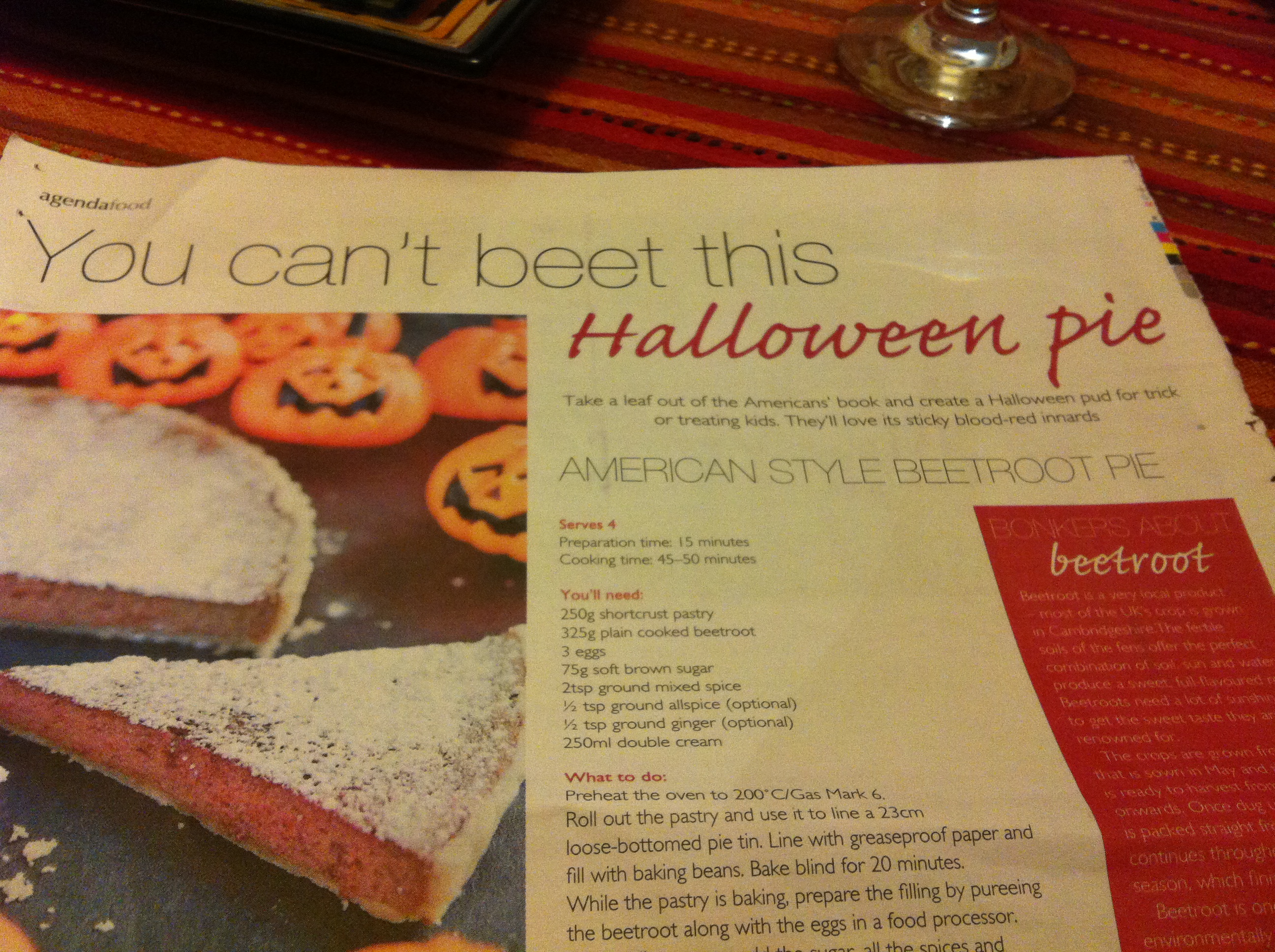
You Can’t Beet this Halloween Pie

“Take a leaf out of the American book and create a Halloween pud for trick or treating kids. They’ll love its sticky blood-red innards.”

Yes, my friends, the British think that we share beetroot pie with our children on Halloween (or would want to?). Perhaps we dole it out on the stoop alongside the Snickers and Milky Ways. Whatever the implication (and this from someone who adores beets), I’m just so sad for my new English friends. Of course you can’t miss what you’ve never known. But beets? Points for creativity and culinary horrors.

Heat of the Moment

It is mid-August and I am wearing a heavy fleece and wool socks, the fuzzy kind you keep in the drawer for the ski lodge. Wrapped around me is a blanket that trails behind like a cape as I scamper from room to room in our Victorian row house, searching for open windows. I haven’t yet tackled the hot-water heaters, and I struggle to turn them on with the onset of dark. Rain pelts the windows and I sit deep in the sofa cushions, my children on my lap. I am not trying to soothe them. This is an act of self-preservation – their bottoms are warm.

Yesterday it was a sunny delight. No more.

Even rain can't stop punting on the River Cam.

My mobile voice mail is bleating. I listen to a message from my friend Kristine who’s in London. “I’m calling to ask if it’s f–king freezing in Cambridge because it’s absolutely freezing down here. I don’t know why I’m surprised by this.”

No, but I am surprised. The fates torture me as I flip open my laptop and read an email from my friend Julie. “It’s gruesomely hot,” she laments  “both in DC and Dallas (where they’re into their 47th consecutive day of triple digit temps) and I’m just totally over summer. Never thought it would happen but it’s true.”

I consider putting my jeans in the drier for a tumble as I  shuffling to the kettle. This is it, my first genuine discovery: tea, the national salve, is also….hot.

I wonder, with a wince, what the weather will be like when winter approaches. Because last I checked, we’re in prime shorts-wearing season here.

Shorts, accessorized with a Snuggie.

Bee Nice

Before we left Washington, DC, my young son had one reaction when encountering a bee – an ear-splitting scream, very Fay Wray in delivery and decibel. But that was before, before, before we left the land of the disease-riddled Tiger mosquito and entered the virtual beehive known as England, where strawberries are succulent, flowers blossom in every raggedy garden and bees rule.

Doing what bees do best, at the Cambridge Botanical Garden

There was a time, just months ago,  when I’d consider the current visitation a “swarm.”  But in fact, these insects (bees, wasps and hoverflies, which masquerade as stinging pests), are so plentiful (in yards, parks, restaurants, even, dare I say it, buzzing in and out of my bedroom windows), that I’ve become desensitized. Cocktails in the garden with bees using my thighs as a landing strip? Sure! Bees in the loo? Come on in.

Some say this year’s crop is particularly intense (I recently saw some stoic Brits evacuate a charming outdoor tea garden as bees bombed their quaking trays of fresh scones.) There is a limit, I’m told.

But even my son now accepts the bugs as part of the landscape, warning “move on bee,” with a flick of his hand. My daughter gleefully squashes them with her tiny shoes. I expect less ennui after their first stings. But in truth, I’ll take the risk over a summer of perpetually itchy limbs and the toxic odor of Deet.

Or maybe it’s the crumpets smeared with English set honey that has me numbed into submission. Ask me after I get stung.

Queue You

Britons take their queuing very, very seriously. After living in this country for seven weeks, I would agree with those who say it is akin to an Olympic sport. And who doesn’t like an orderly line? But the fervor goes well beyond just lining up. Here, it’s the ultimate test of civility and order. And if you break the code, well, prepare yourself.

So, now you’re thinking ‘yes, got it, check, check and double-check, visit England, stand politely in line.’ But the unspoken rules are  actually a bit more complicated. It’s not just knowing not to hop a line. It’s also how you get into the queue, how you interact with others, and, God forbid, should you must, how to abdicate your place in a queue.

No, After You

Start by understanding that only an unhinged person would offer their spot in line to someone else, as I learned inside the venerable John Lewis department store. The wait outside the small elevators was long. I had a stroller. As the lift doors opened I offered to let someone else go ahead. “I’ll just wait,” I said, politely. Those words, I realized later, were

The all-mighty queue

tantamount to lobbing a grenade. The stares were penetrating, followed by the insistence that I MUST enter the lift. “No really, it’s fine,” I said, thinking myself the ultra-polite American. “I’ll take the next one.” More concern, more harrumphing.

I was a most rude creature, you could see it in their eyes. Or perhaps I needed institutionalization. Best to get in the lift and give me space to medicate, which they all did.

Like Magic: the Queue

A week later I was at the beach in Cornwall. Standing on a windy bluff, waiting for a ferry, I stopped with my son to admire the view. The boat was nowhere in sight, it would be a good ten minutes before the tiny passenger ship arrived, but as I turned around on the gravel boat ramp I discovered that 20 people had formed a queue behind me. A queue, not far from Land’s End, but there it was, attached to me like a tail.

My Turn? Really?

Perhaps my favorite encounter thus far, involved a little ice cream shop in the center of Cambridge. I stopped in to buy my children a treat on a hot day (yes they do occur here, if infrequently). I was the only one inside. I approached the counter, realized I’d left my wallet with my husband  and popped out to get it. On my return I found the shopkeeper telling another customer he would have to wait in the queue. He looked around at the empty shop. You see, even outside, I WAS the queue. I approached the til and suggested the young man go first but both he and the shop keeper Insisted it was my turn.

For all I know the chap is still waiting for a scoop.
Talk Big, Live Small

Long before I knew I was moving overseas, I loved hearing my husband tell the story of his days as a child spent at Lambrook, a prep school in Berkshire, west of London.  Naturally, his mother sent him to school with a trunk packed with clothes, the necessities. But a week after his arrival, seven of the ten pairs of skivvies she sent were returned home with a note explaining that the boys would need only three: one for the hook, one for the laundry and one for wearing. Until now, I just assumed the proctors were being tight with the kids’ things. But after spending a week searching for a rental home in England, I get it.

Of course you’ve heard tell that English homes are small. Certainly I had. And we packed accordingly for the move, sending a good third of our belongings to government storage before the moving trucks came.  What this shoe and clothing lover never grasped was the fact that English homes (old and many new)  aren’t just physically small, they simply do not have closets. Storage is a fantasy. Economy is key. And Americans, even those of us who  routinely purge the excesses of the occasional retail therapy binge, do not economize. We have three of everything.

And that does not fly here. The stoves are small, the refrigerators are small (no shopping at Costco, sorry), the clothes washers and driers are petite (sometimes they’re the miserable all-in-on variety that have a two-hour dry cycle and produce little more than damp togs).  The closets…zippo. And I’m not talking cheapo housing here. This is grade-A real estate in Cambridge.

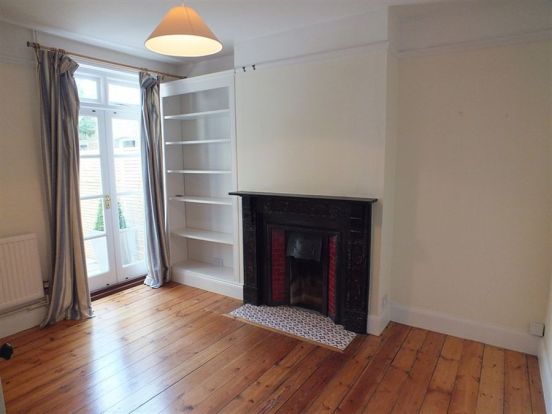
On our first visit to our would-be rental, a beautiful Victorian row house, I tittered in disbelief at the not-so-sumptuous dimensions of the “fifth” bedroom, which measured 8-feet-by-9-feet and, like all the other bedrooms, was devoid of closets. This does not explain why we like it so much.

I have been told by an all-knowing, highly sympathetic expat, that the UK has a booming cottage industry for storage solutions (beds that rise on hydraulics to reveal a season of packed clothing), organizers galore to fit tight spaces, a wardrobe for every occasion.  Just think about what you put in your closets – from ironing boards to vacuum cleaners, winter coats, the never-ending flotsam and jetsam of our consumer-heavy lives. Once the suitcases are unloaded…where will I put the suitcases?

A rare set of shelves, found in the dining room.


I positively winced yesterday when I entered a Boots pharmacy to buy a set of hot rollers and had but one choice – the large set of 24 curlers. Please…don’t you have a travel set? Something smaller, I whinged? There’s no space in the bathroom for dental floss. Where on Earth would I put this monstrous gadget? More important, how would I survive without the one and only tool that can tame my unruly  hair? In the end I bought the rollers. I am making plans to suspend them from the ceiling, Mission Impossible style.

Over There

I have been blogging for nearly three years about motherhood: runny noses, messy diapers, the world of toddlers, which, if you have one, is undeniably engrossing. But in January, as my husband and I made the decision to leave our insanely comfortable life in the suburbs of Washington, DC for the land of rain and royalty, I became all-too-aware of how little I knew about the Brits beyond the big hats and Henry VIII’s wives, and how little reliable information there was in the mainstream about really taking on a new culture. Let’s face it, we’re not moving to Angola. We speak the same language as the Britons (mostly) and eat some of the same food (I’m being generous here). How difficult could this transition be? I sought out a few books for guidance, and short of visiting London, they were thin. Comically bad. I wanted the unvarnished insider’s view. Do I really have to pour my milk before spooning the sugar to avoid risking an international incident, as one guide warned?

I’m a journalist by trade, an avowed extrovert. Could I survive in the world this one tome depicted – where you do not ever invite neighbors over for a meal lest you strain the bounds of British privacy?

It is best, I was advised, to discuss cats and the weather. Only. My mother-in-law, who has spent a considerable amount of time in the UK, has told me story after story about the bitter cold she says we are sure to experience inside every English home. Sounds great, doesn’t it? On a four-day recon trip in January, I experienced none of these things (well one pub loo was exceptionally icy). The test comes when we begin to assimilate, learning both the ropes of  US government move (it’s called PCS-ing) to finding a suitable school for our children (a difficult-enough task in the USA) and trying to forge the same kinds of friendships we enjoy at home.
I don’t know what we’re going to find on this three-year adventure. But I’m going to give it to you straight: the good (I’m certain there will be plenty), the bad, and the cats.